My UX Research & Design Process
A user-centered, data-driven, and iterative approach to creating meaningful digital experiences
Overview
As a Senior UX Researcher, my approach is user-centered, data-driven, and collaborative. I combine deep expertise in research, design, and prototyping, including knowledge of systems, interaction patterns, and accessibility considerations, to create experiences that truly meet user needs. My work is guided by user feedback, and I believe the best design often works at a subconscious level—users only notice it when it’s missing or not working as it should. Because design—and often business—is rarely linear, I take an iterative approach, with research, design, and validation continuously informing one another as new insights emerge. At the same time, I follow the Human-Centered Design (HCD) process, which provides a structured framework while allowing the flexibility to adapt and respond to new findings throughout the project.
Empathize/ Research
Understanding users is the foundation of every project I work on, and it’s where my passion truly lies. With a B.Sc. in Psychology from the University of Toronto, I have a strong background in experimental research methods, both qualitative and quantitative. I’m deeply interested in working with data, using tools like Qualtrics and Excel to analyze and interpret statistics, and I combine this with hands-on qualitative research to uncover user motivations, behaviors, and pain points.
I have experience conducting research manually—such as interviews, contextual inquiries, diary studies, and affinity mapping—as well as using tools like Dovetail, UserTesting, Miro, and Notion to organize, synthesize, and communicate findings. Competitive analysis complements this work, helping identify market opportunities and inform product strategy.
The insights I gather are synthesized into personas, journey maps, and experience frameworks, which guide design decisions and ensure solutions address the right problems.


Define/ Synthesize
Once research is collected, I analyze and synthesize data to uncover patterns and define core user problems. While tools like UserTesting offer AI-assisted analysis, I take a deliberate, hands-on approach to ensure insights are accurate—AI can surface trends quickly, but it can also misinterpret nuance. I use AI strategically to accelerate initial coding or highlight potential patterns, then apply manual synthesis techniques, such as affinity mapping and insight clustering, to validate findings. This ensures that problem statements and research reports are grounded in real user behavior, clearly communicate user needs to the team, and align stakeholders around the most important challenges.


Ideate / Conceptualize
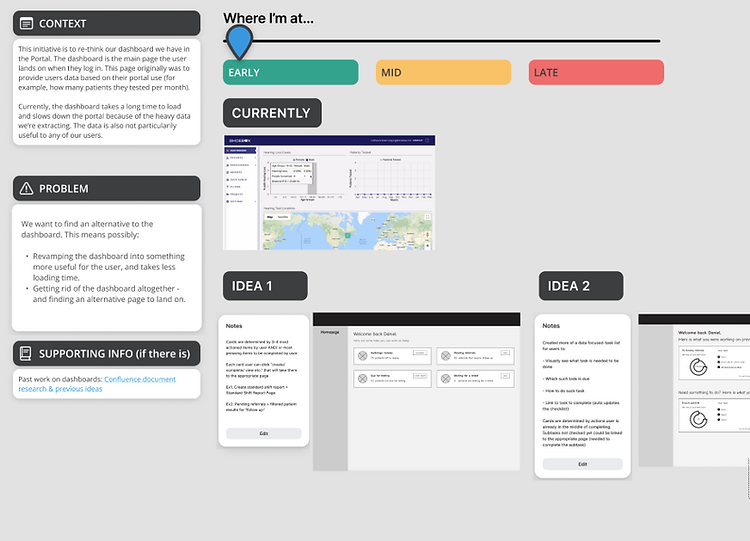
With a clear understanding of user needs, I facilitate ideation sessions with stakeholders and design teams. Using workshops, sketching, and mind mapping, we generate multiple potential solutions. This phase is about exploring possibilities, encouraging creativity, and ensuring that solutions are grounded in user insights. The output is typically wireframes, concept sketches, and solution directions that can be explored further in design.

Prototype / Design
I translate research insights and concepts into tangible prototypes that can be tested with users. This includes low-fidelity sketches, high-fidelity interactive prototypes, and visual design mockups. I also focus on accessibility, interaction patterns, and system consistency to ensure that designs are practical and scalable. Prototypes serve as a bridge between research insights and final implementation, helping the team visualize solutions before development.


Test / Evaluate
User testing is critical to validate assumptions and iterate on design. I conduct usability testing, A/B tests, and heuristic evaluations, often combining qualitative feedback with quantitative data from analytics. Findings from testing inform updates to prototypes and designs, helping the product better meet user needs. Iteration at this stage ensures that solutions are effective, usable, and delightful.

Implement / Deliver
Once a solution is ready, I work closely with developers to ensure smooth handoff and implementation. This includes preparing design specs, reviewing edge cases, supporting accessibility, and performing QA checks. But the process doesn’t stop at delivery. Insights from testing, development, or market feedback often feed back into research or redesign. I embrace this iterative approach to continuously refine solutions, ensuring they remain relevant, effective, and aligned with evolving user needs.
