Helping Millions Easily Discover Their Next Home on REALTOR.ca®
%201%20(3).png)
Overview
Type: Foundational UX Research Initiative (to inform R8 Redesign)
Role: Lead UX Researcher
Duration: 4 weeks
Tools: UserTesting, Miro, FigJam, Confluence
Card sorting informed hierarchy improvements to our Property Details Page (PDP) and led to a key win: the sticky REALTOR® contact launch boosted lead submissions by +28% in its first quarter.
The Challenge & Opportunity
REALTOR.ca® is Canada’s leading real estate marketplace, attracting over 120M visitors and generating 2.1B listing views in 2024. Our team led the research and user experience for the R8 redesign (8th major redesign effort) of REALTOR.ca®.
The challenge: The Property Details Page (PDP)—a critical decision-making touch point with 100–150M monthly views—had never undergone user testing or received historical analysis of its information hierarchy.

The opportunity: when a redesign was proposed, I identified the need for foundational research to understand how users actually navigate and prioritize content — ensuring the redesign aligned with user mental models, not internal assumptions.


R7 Current Design
R8 Proposed Design
At project kickoff, I partnered with the Product Manager to translate leadership team’s vision into clear, measurable, and user-centered objectives, aligning our team around a shared definition of success.
Business Goals

My Approach: Uncovering the User's Mental Model
Mapped the Landscape
With no existing PDP (Product Details Page) IA documentation, I created a preliminary Information Architecture (IA) map to visualize content and features, acting as a shared reference for stakeholders and guided the design of card sorting and interviews.

Synthesized Existing Data
Previous Research
In my previous study of Buyer and Renter personas, we discovered that users approach the Property Details Page (PDP) in distinct ways. Through previous user interviews we identified two primary behaviors:
-
Exploratory buyers:
- Behaviors: glance at details above the fold, focus on impressions, and use actions like “favorite” to save properties for later refinement.
-
Phase: “Exploratory Phase”
-
Need: Rapid exploration
-
- Behaviors: glance at details above the fold, focus on impressions, and use actions like “favorite” to save properties for later refinement.
-
Serious buyers:
-
Behaviors: spend more time reviewing the entire PDP (Product Details Page), revisiting pages and examining detailed information before making decisions.
-
Phase: “Focused Investigation Phase”
-
Need: Deep investigation
-
-


Focused Investigation - View Details “Below the Fold”
Exploratory - View Details “Above the Fold”
CSAT (Customer Satisfaction) Secondary Research
Our CSAT (Customer Satisfaction) survey -which measures how satisfied customers are with a product, service, or experience, via a short survey- of 1,150 users revealed persistent pain points:
-
Data accuracy: missing or inconsistent property details.
-
Feature usability: Ineffective sharing tools.
While these issues could be technical in nature, they may also signal underlying experience problems — particularly how users locate, interpret, and act on property information within the PDP (Product Details Page).
Research Questions
-
How should property details be organized for quick exploration vs. deeper evaluation?
-
Which property information or features most builds user trust and confidence?
-
How can the PDP (Product Details Page) balance quick scanning and in-depth review for different users?
Hypothesis
-
A PDP (Product Details Page) with accurate, prioritized, and navigable content, aligned to user journey phases, enables users to find and understand information more efficiently.
Methodology
-
Conducted a hybrid card sorting study with 24 participants, generating over 500 data points.
-
Held the exercises in a moderated setting using Miro.
-
Spoke with users during the exercise to understand their categorizations.
-
Revealed how and why users expect property information to be organized.
-
Validated hypotheses about content hierarchy and user priorities.
Insights: Qual + Quant Validation
Hybrid Card Sorting Study – PDP (Product Details Page) Insights
-
Participants freely arranged PDP (Product Details Page) cards within guided top–middle–bottom categories.
-
Their groupings naturally aligned with 80% of the current layout, indicating the R7 information architecture aligns with user expectations of how a PDP (Product Details Page) should be laid out.
-
Research shows consistent categorization patterns across users, demonstrating that R7’s IA still resonates conceptually.
How participants naturally organized PDP elements in a card sort, and how this (mostly) aligns with the current PDP.
.png)
How the R8 proposal’s structure supports—or conflicts with—the current R7 IA and users’ natural categorization of information

Card Sorting Insights: Preferred / Expected PDP Content Placement
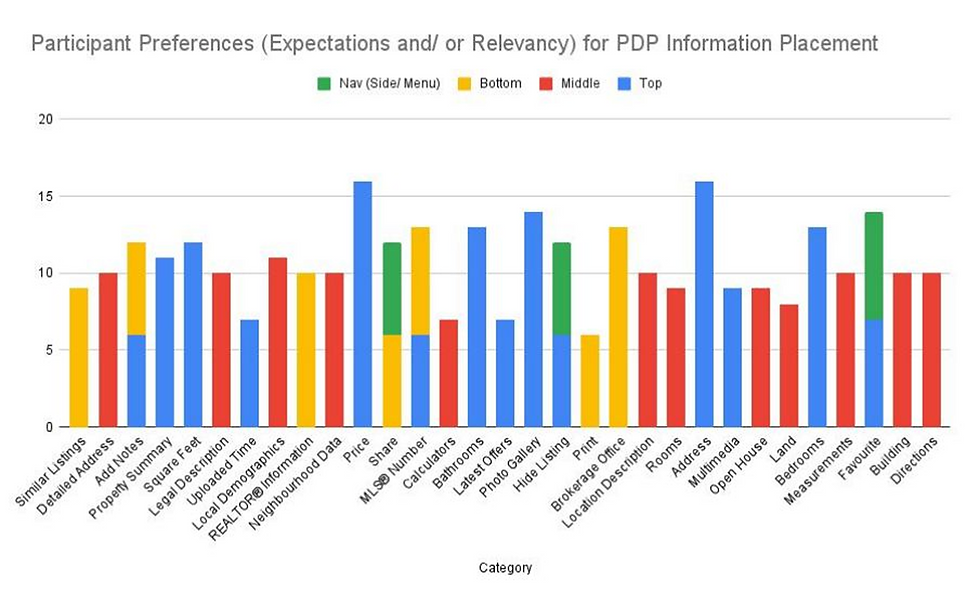
Hypothesis Validation
✅ Alignment with User Journey & Navigation
Card sorting revealed that participants naturally organized PDP (Product Details Page) content in a structure that closely mirrors the current R7 layout:
Top — Quick Exploration
-
Address, price, and photos for rapid assessment.
Middle — Detailed Investigation
-
Building features, room details, and lot information for deeper evaluation.
Bottom — Actions & Lower-Priority Information
-
Contact REALTOR®, similar listings, and secondary details as end-of-journey actions.
❌ Where the R8 Proposal Conflicts with User Expectations
R8 introduces structural changes that disrupt this intuitive flow:
-
Key details hidden or pushed down, weakening the middle investigation zone.
-
Bottom section overloaded with content previously surfaced higher, making important details harder to find.
⚠️ Accuracy and features not tested:
-
CSAT highlights data accuracy and feature issues, though any link to IA remains unclear.
-
Booking section added in R8 despite an existing contact flow.
The hierarchy should align with users’ mental models and confirms that R7’s IA supports expected browsing behavior.
User Behavior Confirmation via Analytics (2021 & 2024)
I also collaborated with our data analyst to review Google Analytics from 2021 and 2024, which aligned with the card-sorting behaviors observed in this study:
-
Photos are consistently clicked first.
-
Listing tabs like Neighborhood are often overlooked but valued once noticed.
-
Print and REALTOR® interactions see minimal engagement, reflecting final-step actions or low relevance.


REALTOR.ca Overview Stats of PDP Features- 2021
Google Analytics 2024
Recommendations: Aligning Structure, Boosting Scannability
Recommendations to Improve R8 with Card Sorting Data
I collaborated with the UI designer to adjust the R8, aligning its information architecture more closely with R7 while implementing the designers’ enhancements to improve feature visibility and scannability.
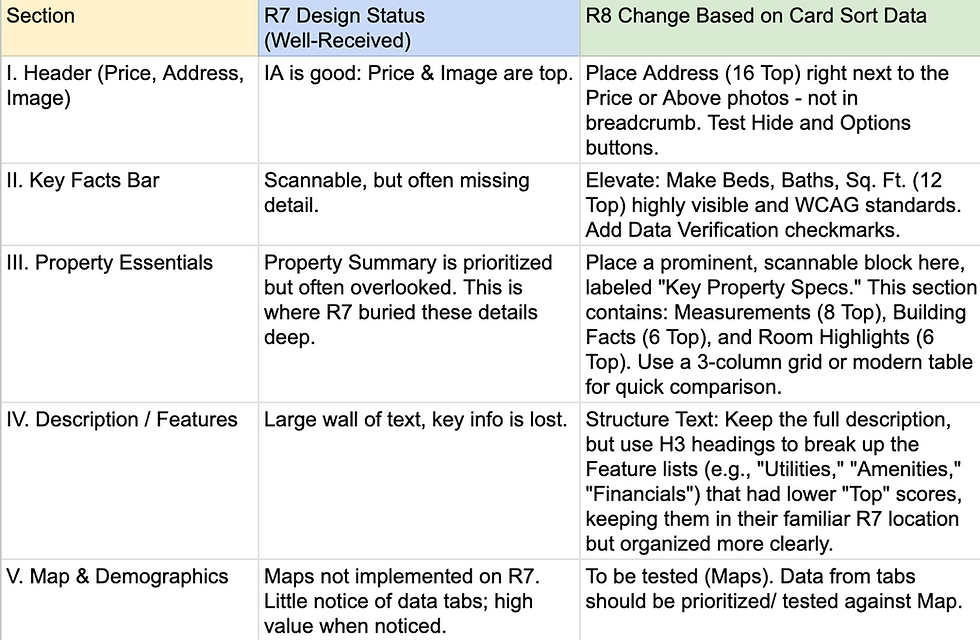
Key updates included:
-
Elevating critical metrics: like beds, baths, and square footage
-
Structuring long descriptions with clear headings
-
Repositioning the most important information (price and address) to the top—making essential information more scannable and aligned with user priorities.
Impact & Reflections
This study de-risked assumptions about how Buyers and Renters prioritize property information. Card sorting with 24 participants generated 500+ data points, revealing why users prioritize certain details and guiding PDP content hierarchy and labeling.
It also highlighted trade-offs: 60% of participants expected REALTOR® contact later, but business goals required it at the top. I recommended a subtle sticky call-to-action to balance user expectations with business priorities, elevating underutilized features.
-
Finalize the R8 redesign – Incorporate findings from the card sorting study to refine the PDP information hierarchy and labeling.
-
Usability testing – Validate that the updated PDP meets user expectations and that key information is easy to find.
-
Address unanswered questions – Investigate open areas such as CSAT, data accuracy concerns, and feature usability to ensure no critical user needs are overlooked.
Although R8 has not officially launched, I’m happy to share that my suggested REALTOR® contact feature went live in mid-2025 and increased lead submissions by 28% in its first post-launch quarter compared with the previous quarter.
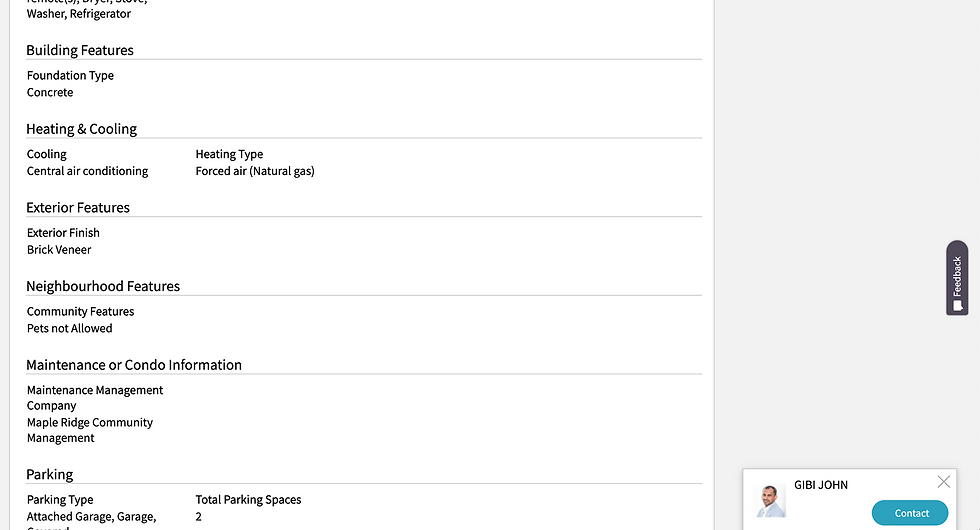
Contact a REALTOR® sticky CTA

Contact a REALTOR® page
